


Dear Bernhard,
in the manifesto of this year’s Rimini Meeting, you ask yourselves where the force that sets reality in motion manifests itself today. From the Sudeten German Pentecost experienced this year at Meeting Brno, I bring with me an amazement that has not yet faded. And with it, an image.
An outstretched hand
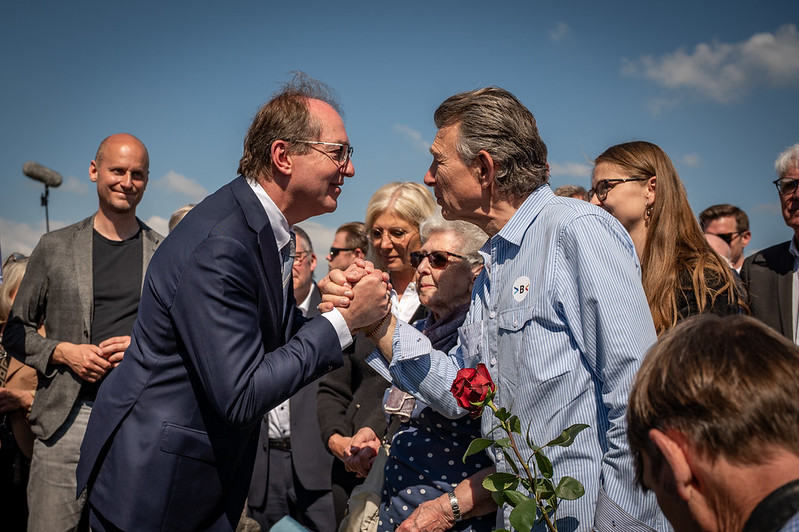
I am introducing Eva Paddock, a ninety-one-year-old woman saved as a Jewish child on one of Sir Nicholas Winton’s trains, to Bernd Posselt, the man who for decades has embodied the memory of the Sudeten Germans violently expelled from Czechoslovakia after the Second World War. “I came from across the ocean to be able to shake your hand,” she told him. In that moment, two great European tragedies met which, according to the logic of the twentieth century, should have remained opposed. For Bernd Posselt, it was the most intense moment of the entire Meeting. Eva added: “I believe that my generation must set the example in healing the past, so that our children, our grandchildren, and future generations can live without the burden of inherited traumas and hatred.”
Touching the wound
This story did not begin with this year’s Pentecost, nor did it begin eleven years ago with the first Pilgrimage of Reconciliation. In a sense, it began back in 1943, when Czechoslovak President Edvard Beneš went to Moscow. When the war was not yet over, he obtained Stalin’s support for the post-war expulsion of three million German-speaking inhabitants of the Czech lands, and at the same time determined the geopolitical orientation of post-war Czechoslovakia. Hundreds of thousands of Czechoslovak citizens died during the Nazi occupation; after the war followed the expulsion of three million Germans, during which tens of thousands of people lost their lives. Thus opened a cultural rift between Czechoslovakia and its Western neighbors, and a few years later, the Iron Curtain would descend into that rift.
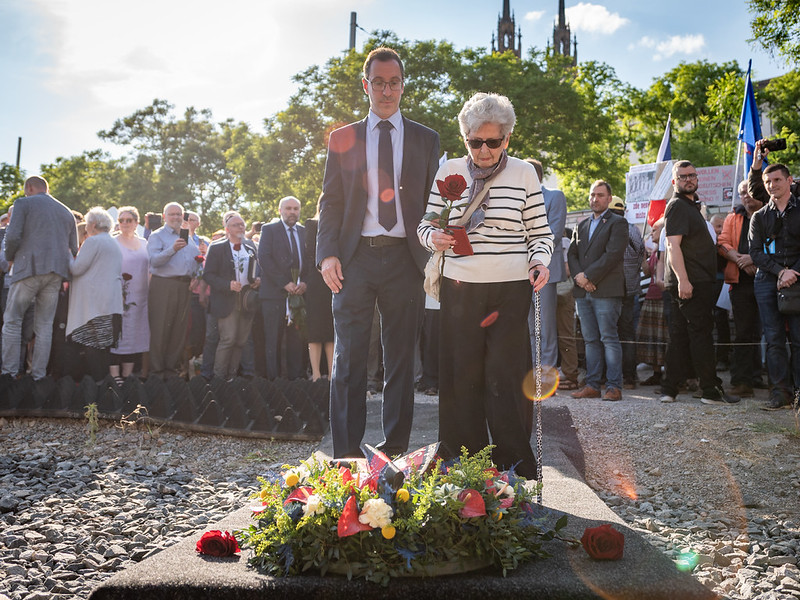
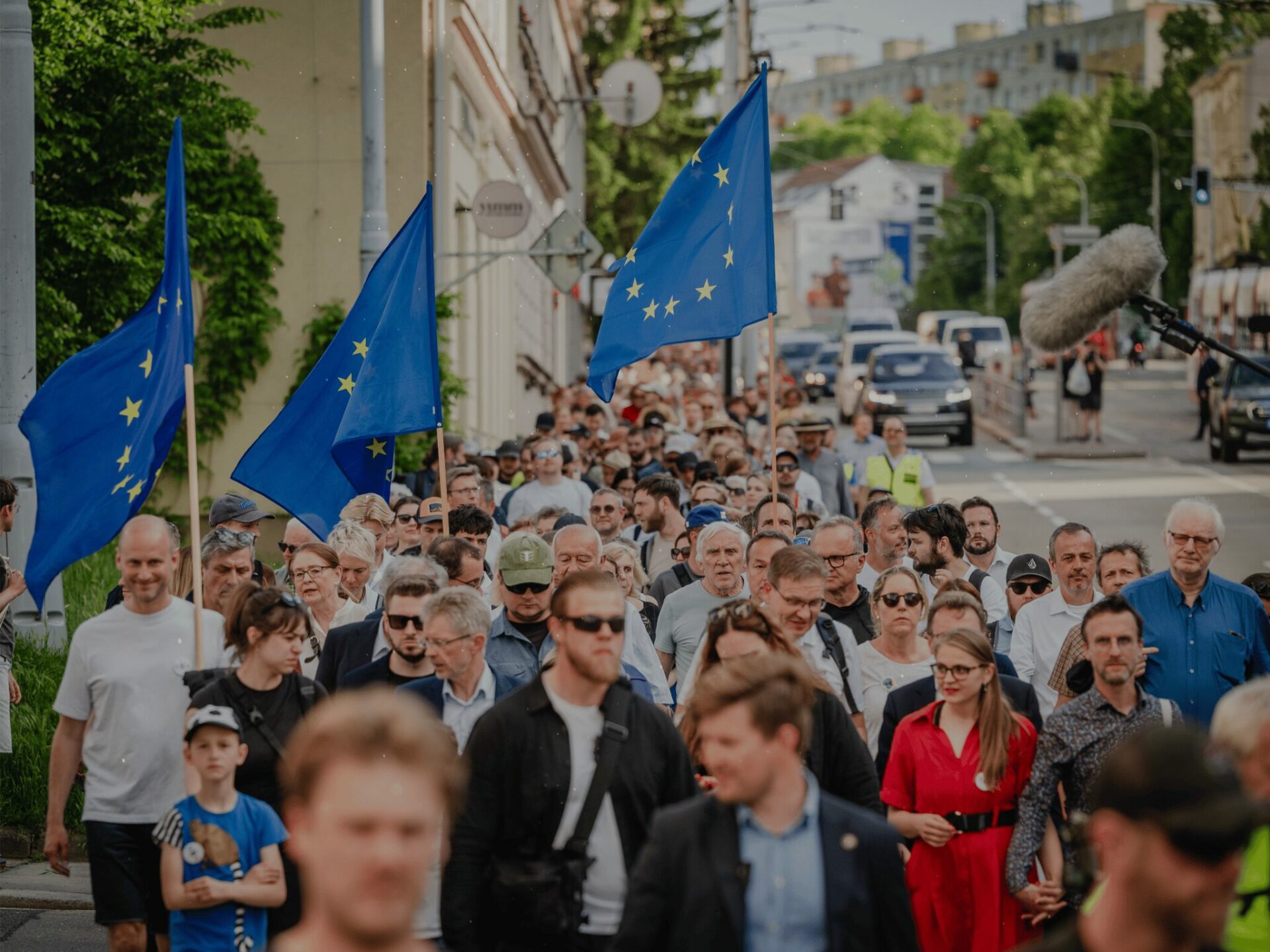
One of the most tragic pages was the so-called Brno Death March of May 1945, during which some thirty thousand women, children, and elderly people were forced to leave the city. Around one thousand seven hundred people died during the march or shortly after. When in May 2015 we undertook the Pilgrimage of Reconciliation for the first time, we walked the opposite path of the expellees, from the mass grave in Pohořelice towards Brno. It was not a historical reconstruction or an attempt to rewrite history, but the desire to touch a wound that had remained taboo for decades: touching the wound like Thomas in Caravaggio’s painting and, in amazement, undertaking a new journey. Václav Havel’s words on the victory of truth and love over lies and hatred became an experience for us, and from this experience, Meeting Brno was born.
A beauty that attracts
I remember a phone call from Kateřina Tučková in August 2015, upon my return from Rimini, asking if I could think of a way to make the spirit of reconciliation we had experienced at the end of the Pilgrimage a permanent presence in the city. I didn’t have to invent anything; I simply recounted the Rimini Meeting. Thus Meeting Brno was born: not as a project, but as a desire to preserve and grow what we had experienced. A year later, this story unexpectedly returned precisely to the Rimini Meeting: in the panel The Story of Meeting Brno: A Journey of Reconciliation, we presented the relations between Czechs and Sudeten Germans as an example of friendship among the peoples of Central Europe. Since then, Bernd Posselt often recalls that it was the first time that, in an international context, Czech-Sudeten German relations were spoken of not as an open wound or an unresolved conflict, but as an experience of reconciliation capable of becoming a proposal for others.
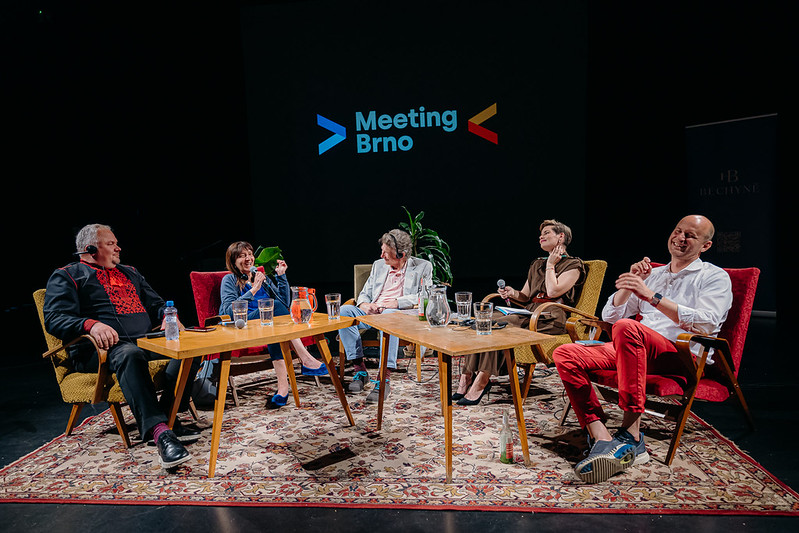
Every year has brought new faces and new stories: Wael Farouq, Emilia Guarnieri, one hundred and twenty descendants of Brno’s Jewish families scattered around the world. Yourself, Bernhard Scholz. The Slovak President and the Czech President. Rami Elhanan and Bassam Aramin, an Israeli and a Palestinian father who lost their children and yet refused hatred. Oleksandra Matviichuk, who documents Russian war crimes in Ukraine, and Boris Belenkin of the Memorial association in Moscow, who at the cost of persecution defended the historical truth about Soviet terror. Every recognized and shared wound opens new horizons, making us experience a beauty that attracts and points out a path. And this year we have seen how far this path can lead us.
Who do we want to be?
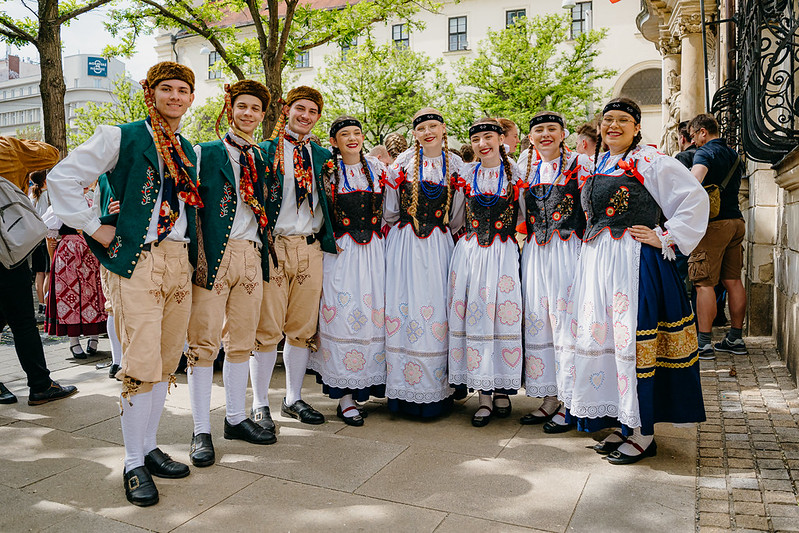
When in 2025 we invited the Sudetendeutscher Tag to Brno, it seemed only a further step in the long journey of Czech-German reconciliation, but in reality, something much larger opened up. A theme that for decades had been relegated to the margins of public debate suddenly found itself at its center. For a long time, an unwritten taboo existed in Czech politics: Sudeten Germans were not spoken of positively, and anyone expressing understanding or closeness risked losing elections and their political career, with the gravest sin being participation in Pentecostal meetings of the Sudetendeutschen in Bavaria. Precisely because of this, the open support expressed this year by numerous institutional representatives was so surprising: it was not just formal declarations, but a personal presence.
Politicians, journalists, historians, activists, commentators, and people who until then had never seriously reflected on the Sudeten German question suddenly entered the public debate, bringing back ancient fears, stereotypes, and wounds. The parliamentary majority in the Chamber of Deputies called an extraordinary session and approved a resolution condemning our initiative and demanding a halt to the preparations, accompanied even by threats of violence and death. At the same time, however, the President of the Republic, the President of the Senate, numerous senators, and all opposition parties expressed their support. But something even more important was happening: people were ceasing to be spectators, and civil society was awakening.
The city of Brno, the South Moravian Region, cultural and educational institutions, churches, volunteers, entrepreneurs: people who had decided to take responsibility for the place where they live. Jan Urban wrote that it was a revolt of civil society against the long inability of political elites to establish genuine dialogue; Erik Tabery, in the weekly Respekt, highlighted a significant paradox: while part of the political representation expended tremendous energy condemning the event, civil society spontaneously created a space for encounter and dialogue. This very contrast helped clarify what was truly at stake. Jana Urbanovská and James Richter noted with great precision that the issue was not primarily about the Sudeten Germans, but about the kind of society we want to be. Even Leo XIV, in the encyclical Magnifica humanitas, poses a similar question to contemporary civilization: what future are we building? In Brno, it wasn’t just the past at stake, but our relationship with the truth, the way we understand our identity, the way we look at the suffering of others, and our ability to build the future not against someone, but together. The Brno Pentecost was not just a chapter in Czech-German relations, it became a proof: is Europe still capable of transforming its wounds into new beginnings?
History in the present
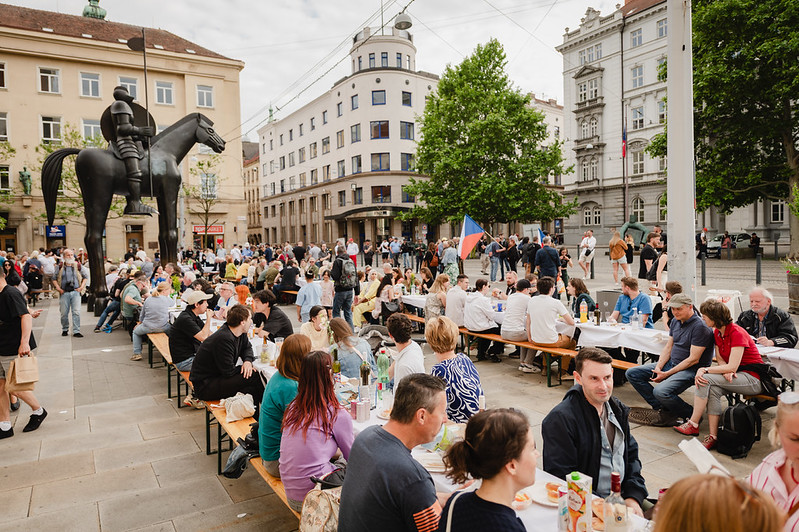
In Moravské náměstí square, a long neighborhood table appeared. At first glance, nothing extraordinary was happening: people were eating together, drinking, laughing, listening to music, dancing, and telling each other their stories. Yet, the strength of the event lay precisely in this. After decades of discussions on history, guilt, rights, and identities, people who in other circumstances might never have met suddenly found themselves sitting next to one another. Czechs and Germans, but also many others: descendants of Nazi victims and descendants of expellees, students, the elderly, politicians, priests, families with children. The past had not disappeared, it sat at the same table with us, but it had ceased to be a wall. On the edges of the square were also those who had come to protest. They had every right to do so, and their presence was important: they could listen to the same stories and see everything with their own eyes, observing that there was no conspiracy against the nation nor any attempt to rewrite history. They saw faces, stories, people sitting at the same table.
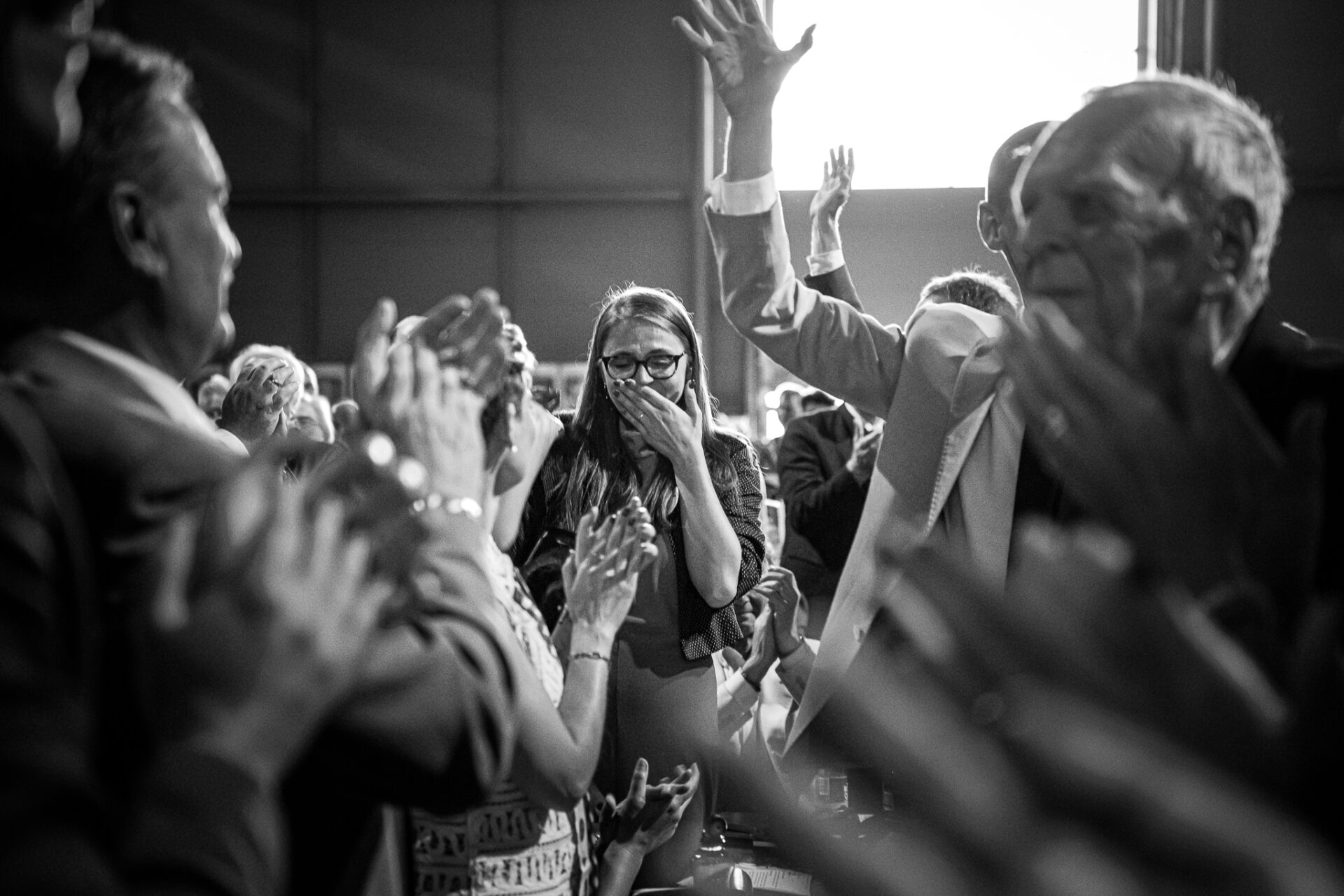
To every objection, I simply replied: “Come and see.” We did not let ourselves get dragged into the logic of enmity. At the end of the program, I publicly thanked the opponents as well, not out of diplomatic courtesy, but because they too were part of the same experience and helped bring to light what was truly happening. Something that is very difficult to program and even harder to organize was becoming increasingly evident: an event. One hundred and forty accredited journalists from various countries arrived to do reports and left with a personal experience. After interviews, they put down their microphones and cameras and began telling their own stories, talking about their families, their experiences under totalitarianisms, or their surprise at what they were seeing in Brno. The boundary between observers and participants dissolved.
But something began to happen outside the media as well. Many people wrote to us that, for the first time in many years, they had started asking their parents and grandparents about stories of the war, the expulsion, communist totalitarianism, or life in the border regions. Themes suppressed or silenced for decades returned to family conversations, memory was awakened, and stories hidden in silence for generations came to light, touching even the families of our team members. Something similar also happened in the political world. Many approached this experience with caution, as the topic was delicate, public debate was heated, and no one knew how that weekend would end. However, the closer the event got, the more evident it became that something going beyond normal political calculations was happening.
I remember the face of the South Moravian Governor Jan Grolich as he said that a small group of people had managed to create a space where a society learns to dialogue with itself; I remember the personal and moving support of Mayor Markéta Vaňková; and I remember the appeal of Senate President Miloš Vystrčil before almost five thousand pilgrims of reconciliation, stating that an experience like that of Meeting Brno would be good for every city in the Czech Republic. Perhaps it was right here that the Pentecostal dimension of the whole event manifested itself most clearly: for years, from a political point of view, it had been safer to stay silent, and it was all the more surprising to see politicians who until recently had hesitated, arriving, listening, and beginning to publicly name what was before their eyes, proposing this experience to others as well. In the manifesto of this year’s Rimini Meeting, you ask whether a politics and economics inspired by the logic of the gift can return to serving the common good: in Brno, we were able to see an answer.
Alongside the cultural and spiritual dimension, a space for new relationships between Moravian and Bavarian cities, regions, universities, entrepreneurs, and institutions was born. Bavarian Minister-President Markus Söder arrived in Brno, and representatives of local administrations, universities, chambers of commerce, and innovation centers participated. It was not a side program, but another dimension of the event: reconciliation is not a feeling, it generates trust, and trust opens up new forms of collaboration not only between individuals, but also between regions, institutions, and peoples. In this sense, the Sudetendeutscher Tag was not only an event of memory, but an investment in the future. Bavarian Deputy Minister-President Ulrike Scharf, upon returning to Germany, said she had experienced “history in the present” in Brno, while for Bernd Posselt this Pentecost represented the fulfillment of a lifelong dream. As Prague photographer Eugen Kukla wrote: “I am understanding it slowly, but precisely for this reason with even greater force: in Brno, I witnessed an event of fundamental importance for Central Europe, whose impact will be measured in centuries.” For a few days, the past ceased to appear as a burden dragging us backward and became a source of energy for a new beginning.
A laboratory of the future
Among the guests at this year’s Meeting Brno were also people from Ukraine. They had not come to study Czech or German history, but came from a country that faces war, occupation, massacres of civilians, and questions with no simple answers every day. Elena Mazzola and the “angel of Bucha” Konstantin Gudauskas arrived, modern Wintons united by the rescue of people affected by the war and by the same question that has accompanied Ukraine since the first days of the Russian invasion: how not to lose humanity during and after the war? How to defend the heart from hatred? For them, the Pilgrimage of Reconciliation and the Sudetendeutscher Tag became a laboratory of the future: they observed a society learning to speak of its own faults without losing dignity, capable of weeping for its own dead without losing the ability to see the suffering of others. A society in which memory does not become a weapon, but a path.
It was said many times during those days that one day Ukraine will face the same questions that Europe had to face after 1945: how to deal with pain? How to name the crimes? How to restore justice and prevent legitimate anger from turning into revenge? “The greatest victory of the aggressor would not be the occupation of another territory, but the moment the victim accepted its logic and let their heart be poisoned by hatred,” Elena reminded us. Nick Winton, son of Sir Nicholas Winton, wrote that forgiveness does not mean denying guilt, but accepting reality and deciding to move forward; what was at stake was the freedom of a person who refuses to be defined by their wound. A similar tone also resonates in the words of the new Archbishop of Prague, Stanislav Přibyl, who in his speeches at the sites of post-war massacres often recalls that old wounds must be reopened in order to heal, and that instead of building walls, we must build bridges.
The strength of a voice
Reconciliation is not only about the past, but also about the truth. And it is precisely here that the Brno experience naturally meets the legacy of Charter 77, on the eve of the fiftieth anniversary of its birth and the death of Jan Patočka. Charter 77 was not primarily a protest against the regime, but an attempt to return truth to the public space; which is why its questions remain alive today. For Patočka, the responsibility of a person who refuses to reconcile with lies and is willing to bear the consequences of the truth was decisive. Meeting Brno 2027 will bear the title The strength of a voice, posing crucial questions: what must be said today? What wounds have we learned to bypass? What lies have we accepted as obvious? And what gives us the courage to look at reality without fear?
These questions concern all of Europe, indeed the entire West. We have become accustomed to peace, security, and growing prosperity, and today we once again face war on our borders, the return of imperial ambitions, the crisis of trust in democratic institutions, and the temptation to lock ourselves in our fears and resentments. Jan Urban, one of the signatories of Charter 77, often repeats that Europe must learn to think and act in a European way: not as a technocratic project or a system of institutions, but as a community of people who take responsibility for the world in which they live. In the encyclical Magnifica humanitas, Leo XIV writes that humanity today faces a choice between a new Tower of Babel and a city in which God and humans can dwell together, in which differences are not a wall, but the beginning of a relationship. It is in this sense that the Brno Pentecost appears to me as an event of European significance: it showed that civil society is still capable of opening paths where there seemed to be only dead ends, that encounter is stronger than stereotype, that truth does not necessarily lead to division, and that reconciliation is not a weakness, but one of the highest forms of courage.
Surprised by reality
The strength of a voice recalls the figure of John the Baptist, who did not proclaim himself the light or the savior, but only said he was a voice preparing the way. The true protagonist of history is not the one who manipulates or dominates, but the person willing to respond to the reality that comes to meet them, who takes responsibility for their small piece of the world, and who is surprised when what could not be foreseen happens. The manifesto of the “festival of amazement” of the Rimini Meeting 2026 concludes with these words:
“Where does this force that moves manifest itself today? In the most unexpected places: (…) in the inventiveness of those who generate beauty where degradation reigns; (…) in the audacity to believe that an enemy can become a friend again and that seemingly blocked relationships can reopen. Not sentimentalism, but life testimonies and concrete experiences in which love reveals itself as the energy that sets back in motion what seemed dead.”
Meeting 2026 wants to verify whether this force is truly the key to understanding reality and living it fully: a love that does not erase differences, but makes them dance together, that takes us outside ourselves to rediscover our truest and greatest self, to set back on its path a world that seems to have stopped. Dear Bernhard, I could not describe the Pentecost of the Sudetendeutscher Tag at Meeting Brno more adequately: we experienced this force. People divided by history became, through encounter, pilgrims of reconciliation; former adversaries discovered they were neighbors and friends; and those who until yesterday were afraid to speak came, saw, and began to invite others to the same experience. History has set itself in motion again. And with it, our amazement.
See you in Rimini!
David Macek


